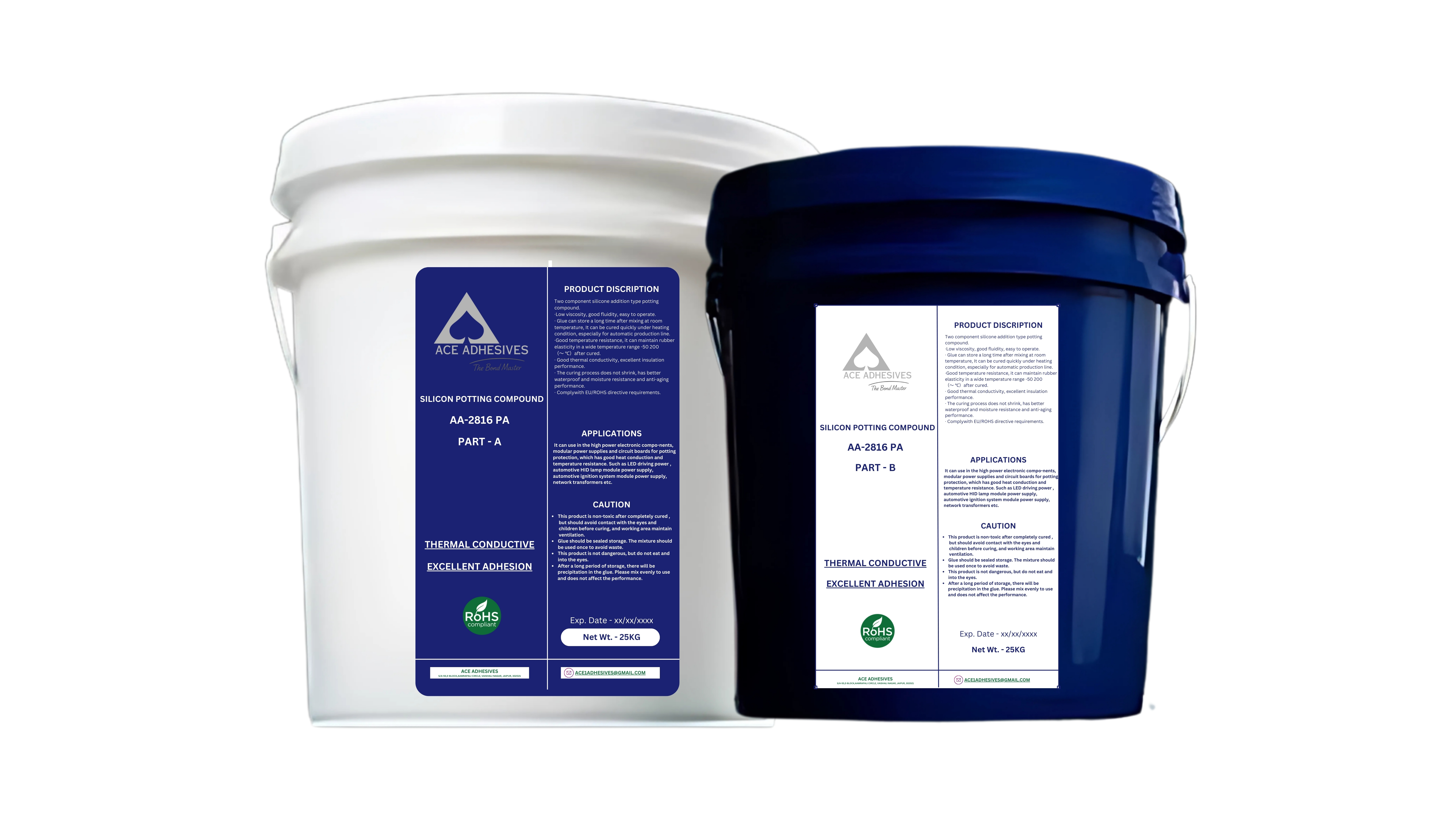
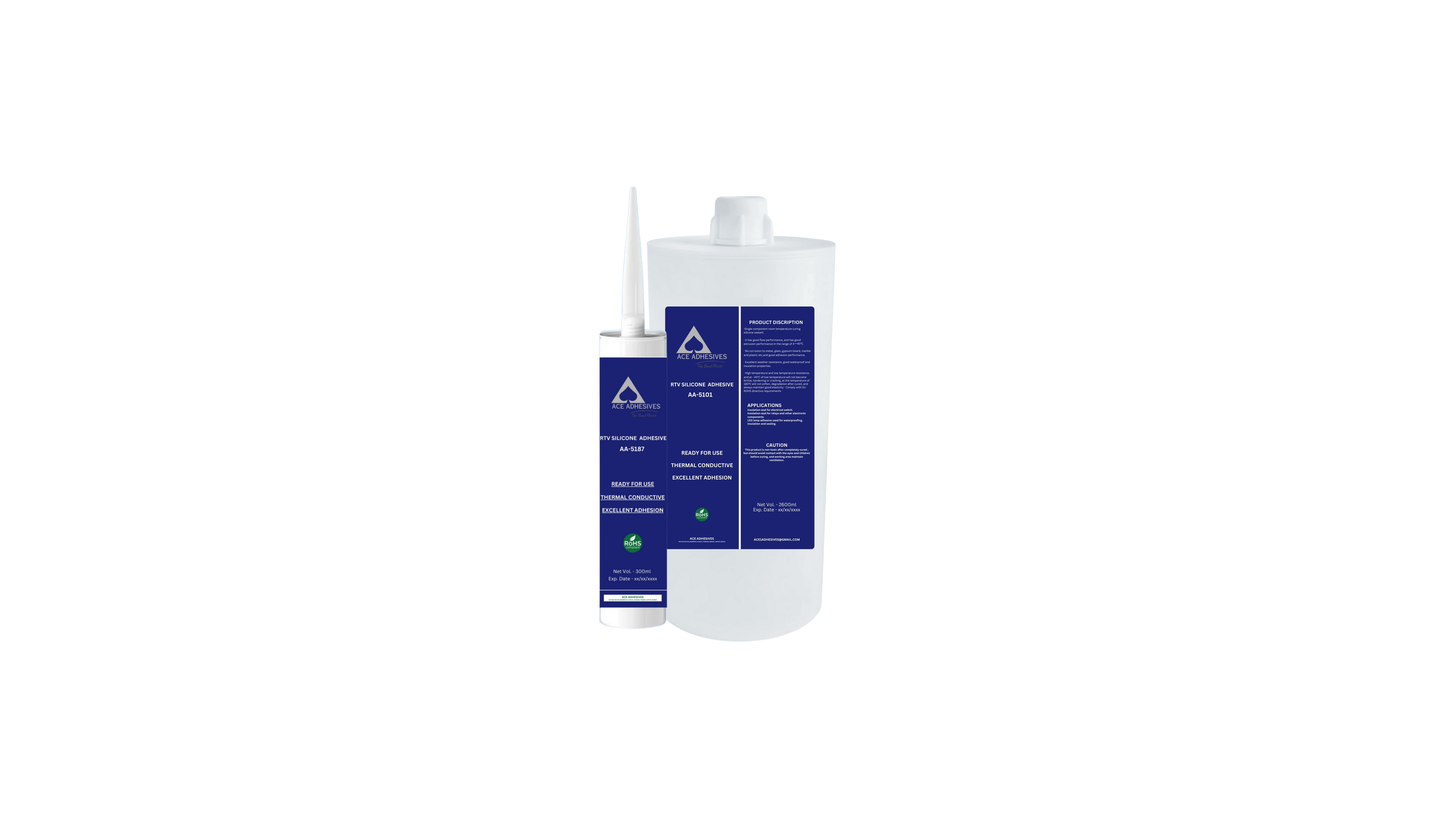
Use silicone potting compound when you want to fill a housing and fully encapsulate a board or module. Use RTV silicone when you want to seal, bond or insulate a joint, an edge or a few components. Potting cures evenly at any depth; RTV cures from the surface inward using moisture in the air, so it suits thin beads and layers. Many products, such as LED lamps, use both.
Side-by-side comparison
Swipe sideways to see the whole table →
| Silicone potting compound | Electronic RTV silicone | |
|---|---|---|
| What it is | Two-part liquid (Part A + Part B), mixed 1:1 by weight | One-part paste, ready to use from the tube |
| How it cures | Addition cure. The whole mass cures evenly at any depth, with no by-products. | Moisture cure. Cures from the surface inward using humidity in the air. |
| Cure time (AceAdhesive data sheets) | 2 to 5 hours at room temperature, or 12 to 30 minutes at 80 °C | Tack-free in 7 to 25 minutes. Full cure in about 24 to 36 hours for 2 to 4 mm; at least 7 days for layers over 6 mm. |
| Depth and enclosed spaces | Any depth, including fully closed housings | Best in thin sections. Cures poorly deep inside closed spaces, because it needs air. |
| Flow | Low viscosity. Self-levels and flows around components. | Non-sag paste. Stays where you apply it, even on vertical joints. |
| Equipment | Scale, mixing cups and ideally a vacuum chamber, or a meter-mix machine | Tube or caulking gun |
| Typical uses | LED drivers, power supplies, transformers, ignition and control modules | Sealing lamp housings and cable entries, bonding LEDs and drivers to heat sinks, insulating switches and relays |
| Rework | Difficult; the cured rubber has to be cut out | Easier; the bead can be cut away |
| Watch out for | Cure inhibition by sulfur, tin, amines and similar contaminants | Very dry air slows the cure; do not close it inside a sealed space before it cures |
| Thermal conductivity range | 0.87 to 3.0 W/m·K | 0.4 to 2.5 W/m·K |
| Packing | 25 kg Part A + 25 kg Part B | 300 ml and 2600 ml tubes |
Choose potting compound when
- the whole board has to be protected from water, moisture, dust or condensation, for example in outdoor drivers and power supplies;
- the assembly faces vibration or shock and every component needs support;
- heat has to spread from many components to the housing walls;
- parts at high voltage need insulation all around them;
- you want a repeatable fill on a production line.
Choose RTV silicone when
- you need to seal or bond a joint, lid, lens or cable entry;
- only a few components need protection or fixing, such as large capacitors that must not vibrate;
- you need to bond an LED board, driver or power part to a heat sink and carry heat across the joint (use a thermally conductive grade such as 2.5 W/m·K AA-5125);
- you work in small quantities or do field repairs without mixing equipment.
Using both in one product
An outdoor LED lamp is a common example. RTV seals the lens, the housing joints and the cable gland, and potting compound fills the driver compartment. Do the steps in this order:
- Apply the RTV and let it cure fully before you pour any potting next to it.
- Run a small test first. Many one-part RTVs contain catalysts, such as tin compounds, that can stop addition-cure potting from curing where the two touch. See why silicone potting does not cure.
- Pour the potting compound.
Use electronics-grade RTV only
General-purpose bathroom silicones with a vinegar smell are acetoxy-cure products. They release acetic acid while curing, which can corrode copper, brass and other metals on a circuit board. AceAdhesive Electronic RTV Silicone is made for electronics and is non-corrosive to metal, glass and plastic, as stated on its data sheet.
Common questions
Can I fill a whole driver housing with RTV?
It is not recommended. RTV cures from the surface inward using moisture from the air. A thick fill inside a housing can stay soft for days, and in a closed space it may never cure fully. Use potting compound for filling.
Can potting compound be used as a sealant or glue?
It is a pourable liquid, so it cannot hold a bead on a vertical joint or around a lid. For sealing and bonding joints, use RTV silicone.
Which one moves more heat?
That depends on the grade. Our potting compounds go up to 3.0 W/m·K and our RTV silicones up to 2.5 W/m·K. See how to choose thermal conductivity.